
AI Cited Layoffs Reach 205,000 and Land Hardest on Customer Service

ResumePulse's August 2026 tracker puts AI-attributed US layoffs at 205,000 through August, already matching the full 2025 figure, concentrated in customer service and compliance roles.
AI Cited Layoffs Reach 205,000 and Land Hardest on Customer Service
ResumePulse's August 2026 tracker puts AI-attributed US layoffs at 205,000 through the first eight months of the year. That figure already matches the full 2025 total. The cuts cluster in customer service, data operations, entry-level software roles and finance back offices, the places where scripted work meets a language model that never sleeps.
This is the number every enterprise CX buyer is quietly reading against their own headcount plan. It should also be the number that reshapes how they split their outsourcing spend.
The layoff curve has bent, and it bent at the service desk
Challenger, Gray & Christmas reported that AI was the leading stated reason for corporate job cuts in March and April 2026. Challenger's April report noted that AI had been cited for 49,135 cuts year-to-date.
Read the two data sets together and the shape is clear. AI is not carving evenly through the workforce. It is carving through the parts of the workforce whose day was already measured in average handle time, adherence, and after-call work. The routine ticket, the password reset, the delivery status query, the balance enquiry. Those interactions are being absorbed by systems that cost cents per conversation and answer instantly.
Sam Altman said by May 2026 that he was "delighted to be wrong" about the pace at which AI would reshape work. That admission is worth noting because it came from the person with the strongest commercial incentive to deny it.
Outsourcing did not shrink. It moved up the stack
The second Outsource Accelerator piece worth reading against the layoff tracker makes the counter-intuitive point. Outsourcing volumes are still growing. Global contact-centre headcount is projected to reach 16.8 million by 2029. The industry is not being hollowed out. It is being sorted.
What is disappearing is the work that a well-tuned model can finish without a human in the loop. What is growing is everything that sits on the other side of an AI handoff. The complaint that has already been escalated once. The retention conversation with a customer whose churn signal just spiked. The regulated interaction where the record of what was said, and how it was said, is itself the product.
That distinction matters for how buyers write their next outsourcing brief. If the brief still reads like a 2019 procurement document, weighted toward seat count and cost per minute, it is buying the layer of work that is deflating in value fastest. If it reads like a 2026 document, it weights complaints handling, regulated advice capture, retention outcomes and quality evidence. Those are the interactions AI escalates into, not away from.
South Africa's offshore proposition sits on the right side of the sort
The South African offshore CX sector has spent the last decade building capacity for exactly the interactions that survive the sort. Complaints intelligence, regulated financial services conversations, retention desks for UK and EMEA consumer brands, multilingual support across 35 languages. This is not the tier of work being absorbed by an autonomous agent. It is the tier the autonomous agent hands off to when the confidence score drops or the customer says the word "ombudsman".
The operational discipline required to hold that tier is different from what a low-cost seat farm can offer. It looks like auto-QA scoring every interaction rather than sampling one in a hundred. It looks like sentiment analytics that flag a conduct risk pattern before the regulator does. It looks like knowledge bases that a human agent and an AI copilot both draw from, with the same version control and the same audit trail. Platforms like QContact are built around that assumption, that AI is standard rather than optional, and that the human sitting at the desk is the escalation path the model was designed to reach.
Buyers who split their spend along these lines get two things at once. They get the cost efficiency of automation on the routine tier, and they get the regulated, evidenced, human-handled tier where the reputational and compliance risk actually lives. Buyers who do not split their spend end up automating the cheap work and outsourcing the expensive work to a partner who cannot evidence how it was handled.
The complaints tier is where the next twelve months will be decided
The 205,000 figure is a headline number. The more interesting number is the one nobody has yet published, which is how many of those displaced roles were the first line of complaints intake. Complaints do not disappear when the front line does. They route somewhere. If they route to an AI system with no human escalation discipline behind it, the complaint becomes a regulator's letter. If they route to a partner who treats the complaint as a strategic signal, with root-cause analytics and a governance layer around it, the complaint becomes intelligence.
That is the conversation the next twelve months of enterprise CX contracts will be built around. The buyers who understand it are already asking their outsourcing partners to show them the auto-QA output, the complaints root-cause register, and the evidence chain that connects a customer sentiment score to a product or process fix. The buyers who do not understand it are still asking for a cost per minute quote.
What to watch next quarter
Three signals are worth tracking as this plays out. First, whether Challenger's monthly AI-attributed cut figure keeps climbing or plateaus as the routine tier finishes deflating. A plateau tells you the sort is nearly complete. Second, whether large enterprise CX contracts up for renewal in Q4 2026 start writing in complaints intelligence and regulatory evidence as scored requirements rather than optional extras. That is the demand signal for the surviving tier. Third, whether the offshore destinations that have historically competed on cost per seat, including South Africa, start being described by analysts in different language, the language of governance, accreditation and regulated interaction capacity.
The layoff tracker will keep updating. What matters more is what the surviving work looks like, and who is set up to handle it. On the current evidence, the answer is not the operator with the cheapest seat. It is the operator whose AI stack, human bench and complaints discipline were designed to work as one system, on the escalation side of the sort.
Ready to talk?
Let's build something great together.
Our team is ready to show you what world-class CX looks like in practice.
Get in TouchRelated Articles

One Year. One Team. A Quarter Million Reasons to Celebrate.
28 April 2026

Humanity at Scale: Why AI in Customer Experience Must Start With People
28 April 2026
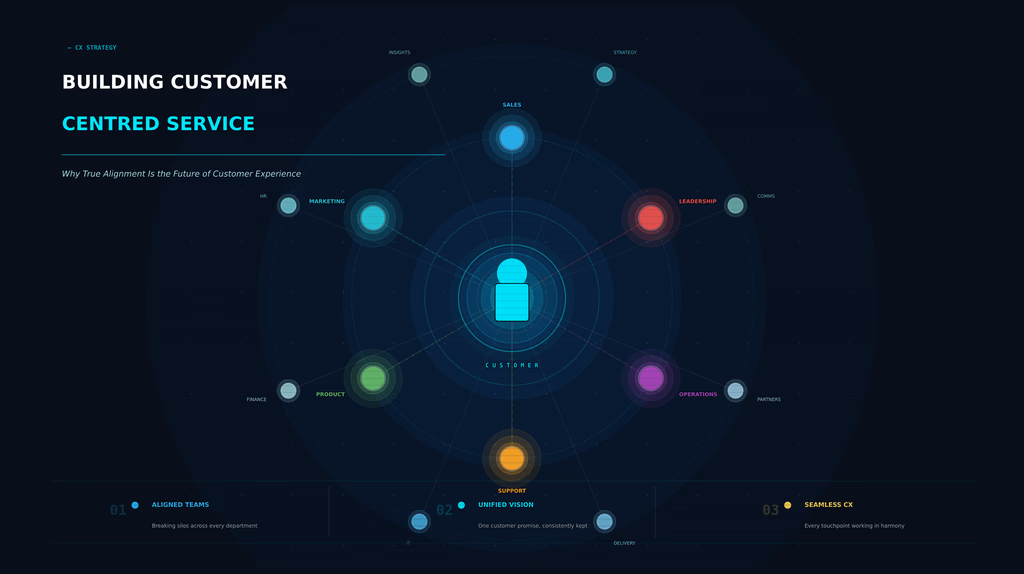
Building Customer Centred Service: Why True Alignment Is the Future of Customer Experience
20 February 2026