
Online Retail Reaches Ten Percent Of South African Turnover

World Wide Worx, with Mastercard, Peach Payments and Ask Afrika, reported on 2 September 2026 that online shopping will average 10% of SA retail turnover in 2026, worth about R159 billion, growing 22.5%.
Online Retail Reaches Ten Percent Of South African Turnover
World Wide Worx, with Mastercard, Peach Payments and Ask Afrika, put a number on it earlier this month. Online shopping will average 10% of South African retail turnover in 2026, worth about R159 billion, growing 22.5% year on year.
Ten percent sounds modest until you sit inside a contact centre and watch what it does to the queue.
A rand that used to leave a shelf leaves a checkout page instead. That single shift in where the transaction happens rewires what the customer calls about. Not "is it in stock", but "where is my order", "why was I charged twice on pay-by-bank", "the courier left it at the wrong gate", "the returns portal will not accept my reference", "why has my BNPL instalment come off early". None of those queries existed at the till.
The payment mix is the part most retail CX operations are underestimating. The World Wide Worx reading points to a fast broadening beyond card, into pay-by-bank, instant EFT, digital wallets and buy-now-pay-later. Each of those rails has its own dispute logic, its own settlement window, its own reason codes, and its own regulator watching how complaints are handled. A contact centre knowledge base built around card chargebacks in 2022 is not fit for a 2026 payment stack.
This is where the omnichannel promise stops being a slogan and starts being an operating problem. If the customer buys on an app, pays with a wallet, gets a courier SMS, queries on WhatsApp and escalates by phone, the agent who eventually picks up the call needs the full thread in one pane. If they do not, first-contact resolution collapses and the customer tells the story again from the top. That is the moment a 10% online share turns into a disproportionate share of complaints.
The knowledge management piece is the quieter failure. Product content, returns policy, delivery SLAs, courier partners, payment providers, BNPL terms, refund windows. In an omnichannel retail operation these change weekly, and the answer the bot gives on Tuesday has to match the answer the agent gives on Thursday. Without a knowledge base that a machine can read and a human can trust, sentiment analysis will simply give you a very well-instrumented view of a growing complaint backlog.
Complaints, treated properly, are the most honest signal a retailer has that its digital operation is working. The National Financial Ombud has been publishing category-level complaint data through 2026, including a 46% rise in fraud-related credit complaints flagged on 11 September. Retail is not far behind. The moment a regulator or a consumer body starts publishing root-cause splits on online delivery failures or BNPL disputes, the retailer that has not been tagging those categories internally will be reading its own diagnosis in the press.
The South African CX operators who serve these books know the shape of the work. Omnichannel routing across voice, chat, email, WhatsApp and social. Auto-QA reading every interaction rather than a 2% sample. Sentiment and conversation analysis surfacing the delivery lane or the payment provider driving the spike this week. Language coverage that reaches the customer in the language they bought in. None of this is exotic. It is table stakes for a retail book that has crossed the 10% online threshold, and it is where South Africa's BPO estate has an edge worth using, both for local retailers and for the UK and EMEA brands that route their online support here.
There is a governance layer to this too. It is not hard to see conduct-style scrutiny travelling from banking into retail complaint handling as online volumes grow. Treating Customers Fairly is a banking regulation, but the principles translate. A retailer that cannot show, on the record, how it identifies vulnerable customers in a delivery dispute, how it escalates a BNPL affordability complaint, and how it closes the loop back into product and credit teams, is carrying a risk it has not priced.
Ten percent is the number the industry will quote for the rest of the year. The operational number that matters is different. It is the share of your total complaint volume that now originates in the online journey, and whether your contact centre can tell you that number by payment method, by courier, by category, this morning. If it cannot, the queue is already ahead of you.
Ready to talk?
Let's build something great together.
Our team is ready to show you what world-class CX looks like in practice.
Get in TouchRelated Articles

One Year. One Team. A Quarter Million Reasons to Celebrate.
28 April 2026

Humanity at Scale: Why AI in Customer Experience Must Start With People
28 April 2026
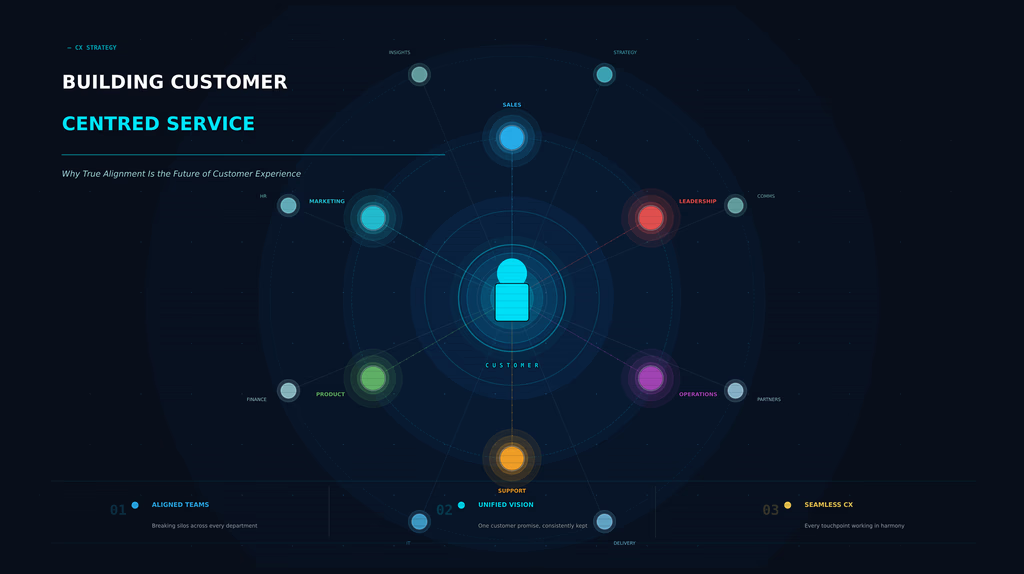
Building Customer Centred Service: Why True Alignment Is the Future of Customer Experience
20 February 2026